

people
OUR BUSINESS

Retail Apparel Group Pty Ltd (RAG) and its brands are 100% owned by The Foschini Group Ltd, a South African retailer listed on the Johannesburg Stock Exchange.
RAG is an Australian menswear and women’s activewear retailer and includes the following brands: Tarocash, yd., Connor, Johnny Bigg, Rockwear and AXL+CO. We have more than 550 stores across Australia and New Zealand where we distribute and sell a range of products. We sell products through physical stores and digital channels.
RAG operates out of our head office in Rosebery, Sydney. Our warehouse operations are spread across New South Wales and Queensland; one is managed directly by RAG and the other by third-party providers.
MODERN SLAVERY
RAG acknowledge the risk of Modern Slavery in global supply chains.
We are committed to achieving an ethical, legal and responsible approach to business, and ensuring effective processes and controls are in place to safeguard against Modern Slavery within our business operations and our supply chain. We will continue to work with suppliers to achieve this goal.
At this uncertain time during the COVID-19 pandemic, we acknowledge that there is a directly attributable increase in the risk of Modern Slavery in our supply chain and operations. We have considered this additional risk and adjusted our procedures where appropriate in line with the current environment.
OUR OPERATIONS AND SUPPLY CHAIN
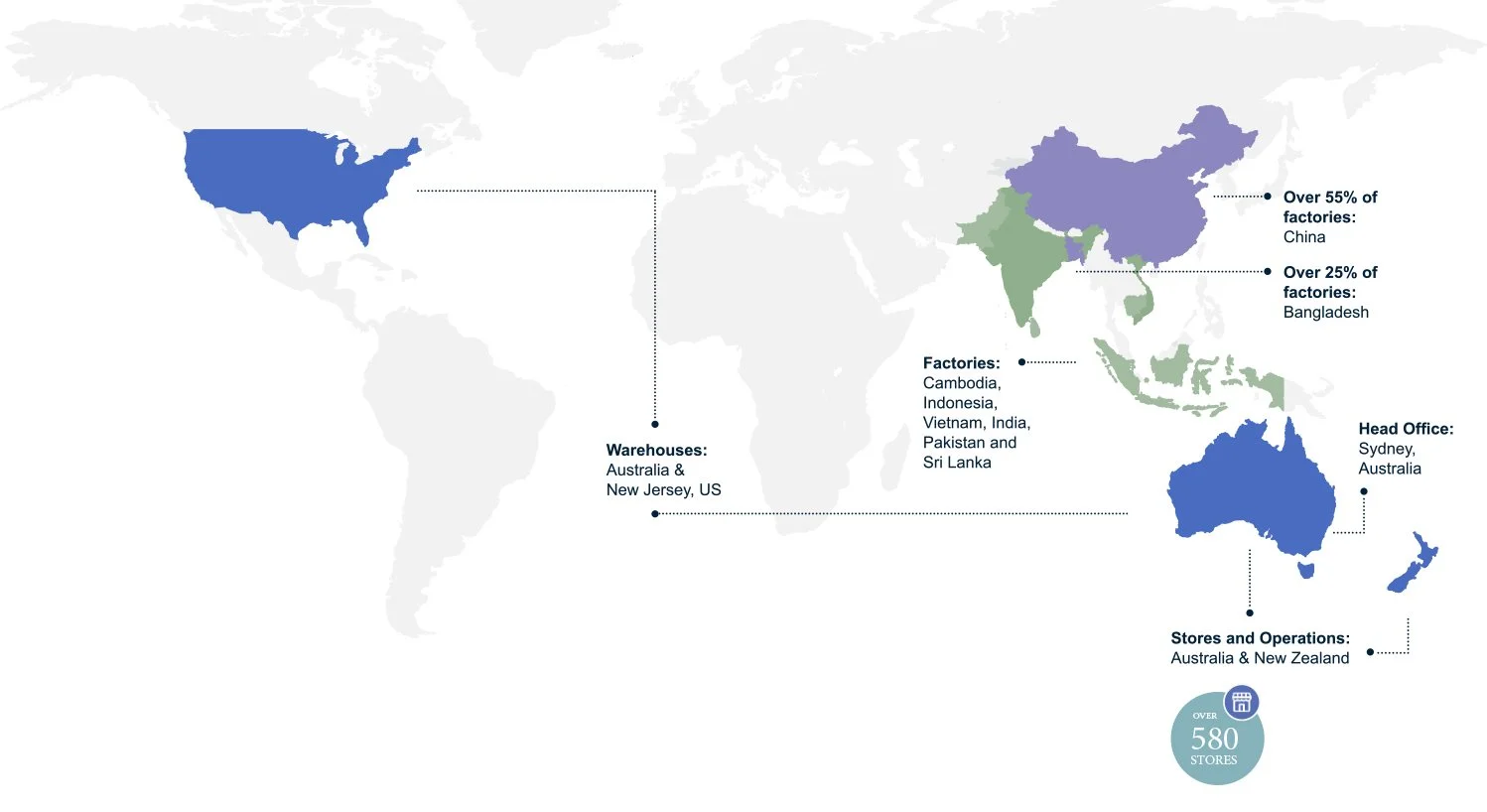
RAG’s high-quality products are produced in numerous countries across the world.
Whilst we do not own or operate factories, we have developed considerable long-term relationships with our valued suppliers and are proud of the working relationships we share.
We collaborate with these suppliers to ensure the working environments in which our products are made are compliant with and align to RAG’s Responsible Sourcing Principles which specifically address modern slavery.
We acknowledge that our supply chains are complex and include various stages, geographies and skill sets to bring our products from raw materials through to finished products. These include the factories where garments are completed; the locations where materials are developed and made into fabric such as in various mills and dye houses; and further down the line, our raw materials which come from farms and various wholesaling relationships.
At present, RAG’s strongest relationships are with the suppliers who are at the final stage of our manufacturing process. As a result, our current procedures focus on addressing modern slavery risks in this labour-intensive process. We recognize that there is a need to continue expanding these procedures further down our supply chain.
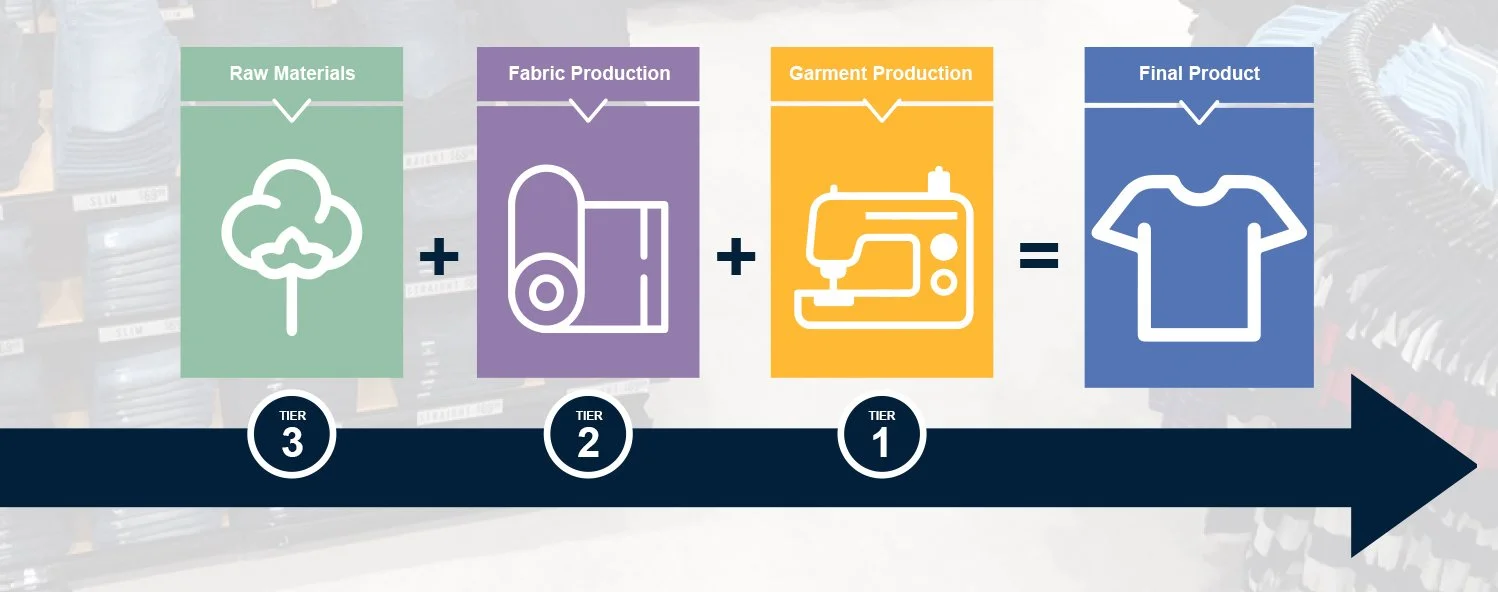
STAGES IN PRODUCING OUR PRODUCTS
IDENTIFIED MODERN SLAVERY RISKS IN OUR OPERATIONS AND SUPPLY CHAIN
-
DEFINITION: RAG Brands and Operations
DESCRIPTION: Warehouses, Stores and Head Office
TRACEABILITY STATUS: Fully mapped
MODERN SLAVERY RISKS IDENTIFIED: Forced labour and debt bondage in our third-party warehouses
-
DEFINITION: Final Stage Production
DESCRIPTION: A factory that cuts, trims and/or sews RAG products
TRACEABILITY STATUS: Fully mapped
MODERN SLAVERY RISKS IDENTIFIED: Child labour; forced and migrant labour; and debt bondage in the manufacturing and finishing of our products
CURRENT PROCEDURES:
Regular announced and unannounced inspections performed for all suppliers
Grievance Hotline in place for all factories
NEXT STEPS: Roll out supplier training on our Responsible Sourcing Principles and compliance procedures
-
DEFINITION: Inputs
DESCRIPTION: Fabric mills, dye houses, wash houses, labelling, hanger suppliers, cartons etc.
TRACEABILITY STATUS: Almost fully mapped
MODERN SLAVERY RISKS IDENTIFIED: Child labour; forced labour and migrant labour; and debt bondage in the production and manufacture of leather
CURRENT PROCEDURES: Review of current audit accreditations
NEXT STEPS: Develop audit program to monitor social, ethical and environmental compliance
-
DEFINITION: Raw Materials
DESCRIPTION: Raw material suppliers for (e.g., Cotton or linen farm, Polyester chips)
TRACEABILITY STATUS: Mapping project initiated (we have traced over 50% of our linen raw material to the farm in which it was picked. These have all been in Europe)
MODERN SLAVERY RISKS IDENTIFIED: Child labour; debt bondage; forced labour and migrant labour; human trafficking; and slavery in the farming/growing/ picking of our raw materials
CURRENT PROCEDURES: Strategy and procedures are in development
NEXT STEPS:
Further trace deeper into our raw materials
Develop our strategy to source more sustainable cotton and polyester
ADDRESSING MODERN SLAVERY RISK: OUR APPROACH
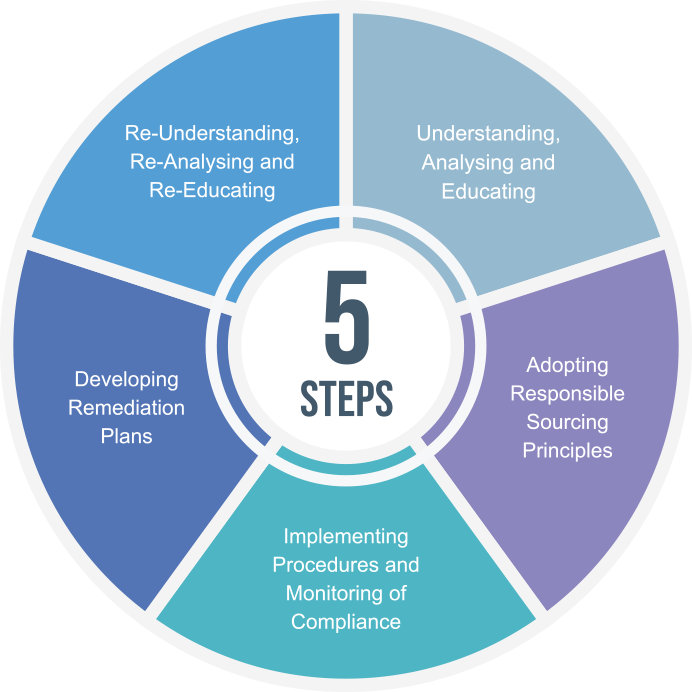
1. Understanding, Analysing and Educating
We acknowledge that Modern Slavery is a risk in our operations and supply chain and are committed to analysing the risk, addressing the risk and educating our business. This is an ongoing analysis and education process that we will continue to question and investigate as our experience, environment and industry evolve.
Our head office teams have engaged in training to understand Modern Slavery, the Modern Slavery Act and what this means for RAG and their teams specifically. We collaborate externally with Non-Government Organisations (NGO’s), other organisations and universities to ensure we are kept up to date with the requirements of the Act, global risks and changing environments so that our approach flexes and evolves.
We know that true change takes time and that signing this statement is just another positive step towards reaching our ultimate goals.
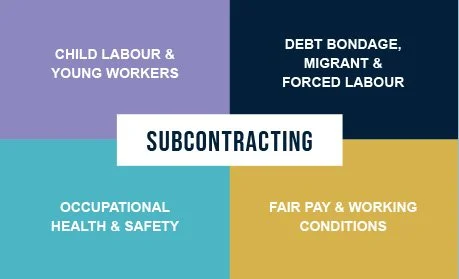
In the area of product manufacture from tier 1 to tier 3 suppliers we acknowledge that child labour, debt bondage, forced labour and migrant labour present the key inherent risks of Modern Slavery within our supply chain. Our procedures, which check for occupational health & safety standards, fair pay & working conditions, and sub-contracting, act as warning indicators for these key Modern Slavery risks.
2. ADOPTING RAG’S RESPONSIBLE SOURCING PRINCIPLES
The foundation of RAG’s approach to Modern Slavery is built on our Responsible Sourcing Principles.
These principles define our core sourcing values:
No child labour
No forced labour
No harassment or abuse
No discrimination
No excessive overtime
Appropriate compensation
Compliance with laws
Healthy & safe workplace
Freedom of association & collective bargaining
Environmental awareness & protection
No bribery or corruption
Transparency in all business relationships
Responsible raw material sourcing
Upholding RAG’s responsible sourcing principles
3. IMPLEMENTING PROCEDURES AND MONITORING OF COMPLIANCE
To monitor compliance with these principles and local laws across our supply chain, all of our tier 1 suppliers must adopt these principles, evidenced through signing our Supplier Code of Conduct. We monitor and analyse completion and measure the effectiveness of our procedures through our monthly brand compliance dashboard through Key Performance indicators. See some examples below:
-
All suppliers are required to sign up to our Code as part of our onboarding procedures.
-
We conduct at least bi-annual independent third-party social and ethical audits of all our tier 1 suppliers in line with the Code.
-
We map our tier 1 and tier 2 suppliers.
-
All factories must display a worker grievance poster, this provides access to an anonymous grievance hotline for our tier 1 workers.
-
Unannounced inspections focus on their inherent modern slavery risk of child labour, subcontracting, and occupational health & safety.
-
Sanitation investigations as a direct response to COVID-19 risks.
-
Internal training opportunities for head office employees on ethical sourcing and Modern Slavery.
In addition to our ongoing ethical sourcing approach, the COVID-19 pandemic required an immediate response. In support of our suppliers and the valued people who manufacture our garments, RAG continued to pay in full for finished product from our global suppliers. We honoured agreed payment terms as reasonably as possible, providing ongoing communication across our supplier network.
4. dEVELOPING REMEDIATION plans
Any failure of our social and ethical audit requires a corrective action plan to be put in place and implemented. The supplier must be re-audited and achieve a pass before new orders can be placed.
We have also developed remediation response plans to address any issues or concerns which may arise as a result of our procedures in relation to any potential for child and forced labour. We continue to educate ourselves on the best remediation processes and are taking time to collaborate with others, including memberships with local NGO’s. This is a work in progress but one we are committed to investing time and effort into.
5. Re-Understanding, Re-Analysing and Re-Educating
RAG appreciates that the breadth of our supply chain inherently means that there are risks in managing compliance and that the journey towards full transparency will be an ongoing effort. Therefore, our approach so far has been to concentrate our efforts on educating ourselves on Modern Slavery and the risks to our current supply chain and implementing strong foundations & fundamental procedures to address these key risk areas.
NEXT STEPS
Our aims for the next year are:
-
We aim to work with our Fabric Mills to monitor social, ethical and environmental accreditation and practices. We will develop our strategy for monitoring compliance. We continue to diversify our supply chain and are ensuring that a key consideration in this process is the risk assessment of social and ethical risks in new regions, and as required, developing tailored controls to meet these needs.
-
To continue the substantial progress we have made in the last 12 months to further map our supply chain into tier 3.
We also aim to further develop our strategy to source more sustainable cotton and polyester. -
Develop training programs for our internal and external team members and suppliers on sustainable purchasing/production.